

P0299 is a universal OBD-II code indicating that the turbocharger or supercharger isn’t generating enough boost pressure. The ECU expects a specific boost level based on throttle input and engine load, and when that pressure falls short, it logs P0299.
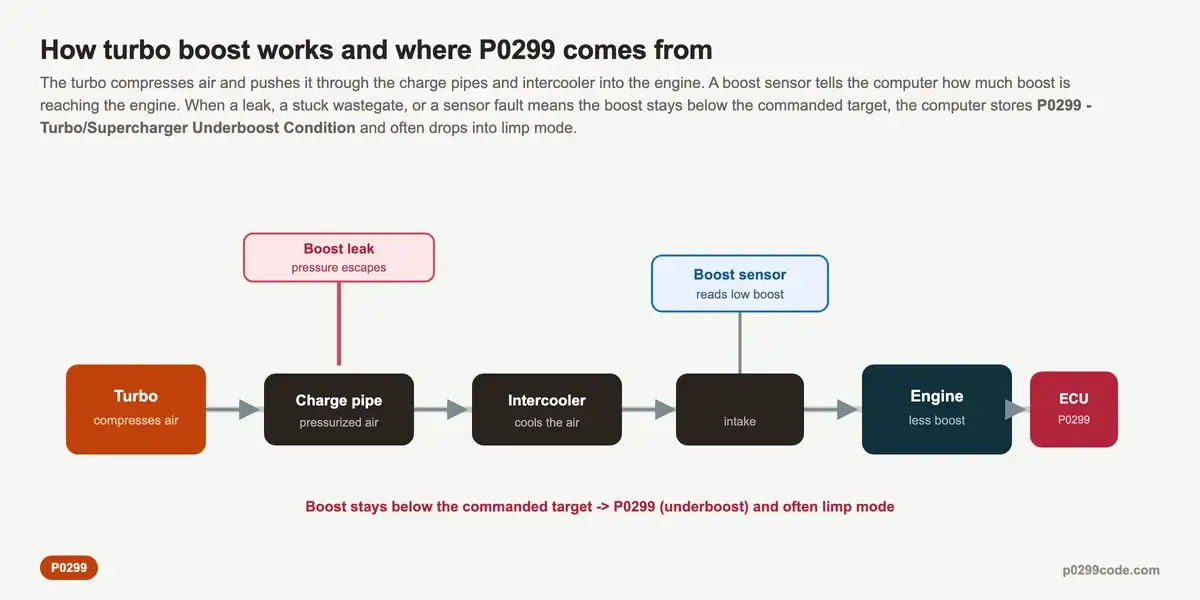
This guide walks you through a clear, direct approach to diagnosing and fixing the problem. Work through each step in order and you’ll reach the root cause without wasting time chasing the wrong parts.
What P0299 Means (Simple Explanation)
When P0299 sets, the engine isn’t receiving enough boost pressure. The result is noticeable power loss and sluggish performance under load.
In short:
- Boost pressure is below specification
- The turbocharger or one of its control components is malfunctioning
Symptoms of P0299
Common Driving Symptoms
- Loss of engine power
- Sluggish acceleration
- Turbo not kicking in
- Whining noise from turbo
- Check Engine Light on
- Increased fuel consumption
- Limp mode in severe cases
Technical Symptoms (Using a Scan Tool)
- Boost pressure reading below expected range
- P0299 code stored in ECU memory
- MAP sensor readings lower than normal under load
Most Common Causes of P0299
1. Boost Leaks
When unmetered air escapes before reaching the engine, boost pressure drops and the ECU never sees the target level.
Typical leak points:
- Cracked intercooler hoses
- Loose clamps
- Split charge pipes
- Faulty intercooler
2. Faulty Diverter or Bypass Valve
The diverter valve regulates boost when the throttle closes. If it sticks open, pressurized air bleeds off instead of building up. This is a very common failure point on turbocharged VW, Audi, and BMW engines.
3. Failing Turbocharger
A worn turbo simply can’t spin up fast enough to hit target boost. Common causes include:
- Worn shaft bearings
- Oil starvation
- Cracked housings or broken fins
4. Wastegate Issues
A wastegate stuck in the open position bleeds boost pressure too early, preventing the turbo from ever reaching target levels.
Possible reasons:
- Weak actuator spring
- Seized mechanical wastegate
- Faulty boost control solenoid
5. Vacuum Leaks
Vacuum-controlled turbos depend on pressure signals to manage boost. Any leak in those lines reduces the control force available to the actuator.
6. Exhaust Restrictions (DPF or Catalytic Converter)
A clogged exhaust creates backpressure that prevents the turbo from spooling up properly.
How to Diagnose P0299 (Step-by-Step)
Follow these steps in order to accurately pinpoint the cause of a turbo/supercharger underboost condition.
Step 1 – Scan Boost and Sensor Data
Connect a scan tool that supports live data and take it for a drive.
- Compare actual boost vs. requested boost under load
- If actual is significantly lower → underboost confirmed
- Check for related codes (P2262, P0234, P0101, P0106, P2227)
Step 2 – Inspect Intake and Intercooler Hoses
Boost leaks are the most common cause of P0299, so start here before pulling anything apart.
- Check for cracks, splits, loose clamps, or disconnected hoses
- Look for oil residue near joints (indicates leaks)
- Spray soapy water while revving → bubbles reveal leaks
Step 3 – Check Diverter or Bypass Valve (Turbo Engines)
Particularly common on VW/Audi and similar platforms, this valve fails more often than people expect.
- Torn diaphragm
- Valve stuck open
- Faulty solenoid or wiring (on electronic types)
Step 4 – Test Wastegate and Actuator
Wastegate operation is crucial for proper boost control and worth testing carefully.
- Apply vacuum or use scan tool to command actuator
- Ensure smooth rod movement
- Inspect for sticking wastegate or weak spring
Step 5 – Inspect Turbocharger or Supercharger
Mechanical failure is less common than a boost leak or valve issue, but when it does happen you need to catch it before the engine takes damage.
- Spin the turbo by hand (engine off): should spin freely
- Check for shaft play, oil leaks, or whining noise
- Superchargers: inspect drive belt and bypass valve
Step 6 – Inspect Boost Solenoid and Vacuum Lines
These components regulate how the turbo behaves across different load conditions.
- Check for cracked or disconnected vacuum lines
- Test solenoid for electrical signal and operation
- Look for corrosion or loose connections
Step 7 – Test MAP and MAF Sensors
A bad sensor can feed the ECU false data and trigger P0299 even when the turbo itself is fine, so don’t skip this step.
- MAP: compare readings at idle and under boost
- MAF: look for low airflow readings
- Clean sensors if dirty; replace if readings are erratic
Step 8 – Check for Exhaust Restrictions
Excessive backpressure can seriously limit turbo performance by starving it of exhaust flow.
- Possible causes: clogged catalytic converter or DPF
- Confirm via backpressure test or thermal scan
Step 9 – Look for ECU Software Issues
On some vehicles, an outdated calibration or known software bug is the actual culprit rather than any hardware fault.
- Search for TSBs (Technical Service Bulletins)
- Some vehicles require an ECU reflash to resolve known underboost issues
How to Fix P0299 (Practical Solutions)
DIY Fixes:
✔ Tighten or replace intercooler hoses and clamps
✔ Clean or replace air filter
✔ Replace diverter valve (common in VW/Audi)
✔ Replace faulty vacuum lines
Professional Fixes:
✔ Replace turbocharger (if failed)
✔ Replace wastegate actuator or solenoid
✔ Replace clogged DPF or catalytic converter
✔ Update ECU software (if known issue)
Summary table of causes and fixes
| Cause | How to Confirm | Fix |
|---|---|---|
| Boost leak | Hissing noise, low boost readings | Replace or tighten hoses/clamps |
| Faulty diverter valve | Valve stuck open, poor boost holding | Replace valve |
| Turbo failure | Whine, shaft play, low airflow | Rebuild or replace turbo |
| Wastegate issue | No actuator movement | Replace actuator or solenoid |
| Vacuum leak | Weak actuator response | Fix or replace vacuum lines |
| Clogged DPF/catalyst | High exhaust pressure, slow spool | Clean or replace filter/converter |
How to confirm the problem is fixed:
After a successful repair:
- Boost matches expected levels
- Engine power returns
- Acceleration is smoother
- No more turbo lag
- Check Engine Light stays off
If the code comes back, recheck the diverter valve, boost control solenoid, or overall turbo condition.
Although P0299 points to an underboost condition, the turbocharger itself is rarely the root cause. Most of the time the problem comes down to a simple boost leak, a faulty diverter or bypass valve, a wastegate that won’t hold, or a sensor sending bad data. Work through the diagnostic steps above and you’ll find the real culprit quickly – and in most cases the fix is straightforward and inexpensive.
Frequently Asked Questions
Is it safe to drive with a P0299 code?
Often the car drops into limp mode with reduced power. You can usually drive gently for a short distance, but fix it soon. A boost leak or a failing turbo can get worse.
What is the most common cause of P0299?
A boost leak from a loose or cracked charge pipe, clamp, or intercooler hose, followed by a stuck wastegate or a boost control fault.
Can I fix P0299 myself?
Often yes for a boost leak. Reseating or replacing a loose charge pipe or clamp is a common DIY fix. A wastegate actuator, boost sensor, or turbocharger needs more skill.
How much does it cost to fix P0299?
From almost nothing (reconnecting a hose) to about 200 to 500 dollars for a boost sensor or wastegate actuator, and 1500 to 3000 or more if the turbocharger needs replacing.
Why does P0299 put my car in limp mode?
When the engine cannot reach the commanded boost, the computer limits power to protect the engine and turbo until the fault is fixed.
Related P0299 and turbo guides
- turbo boost leak: the most common cause of P0299
- wastegate problems and symptoms
- boost pressure sensor symptoms and testing
- P0234: turbo overboost, the opposite code
- What limp mode is and why P0299 triggers it
Sources and Standards
The steps above follow generic OBD-II and turbo service practice. For background and standards, see: